
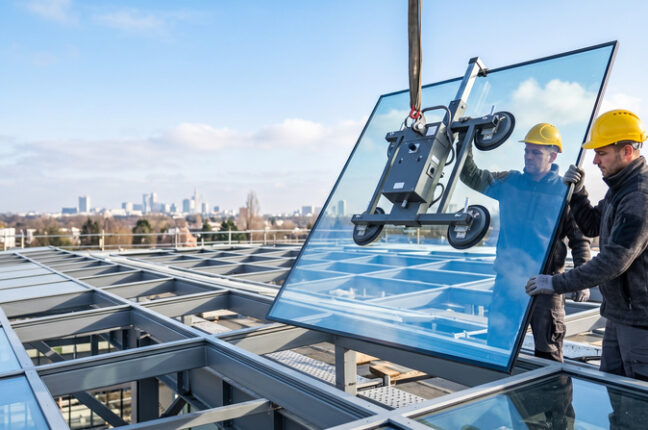
A railway concourse doesn’t close. Neither does an airport terminal, and the bigger coach interchanges run a skeleton service through the small hours rather than locking the doors. That one fact decides nearly everything about how glazing gets repaired in those buildings.
Contractors arriving from the commercial office world usually get a surprise on their first transport job. The glass is the same glass. Nothing else is the same.
The window of work is short and it isn’t negotiable
In an office you can take a lobby out of use for a weekend. In a station you get the gap between the last service and the first one, minus the time it takes to clear passengers out of the area and the time it takes to hand it back clean.
Call it a few hours of tools-on time. Setting up and breaking down eat into that from both ends, and the handback isn’t a courtesy. If the area isn’t open when the first train arrives, the building has a passenger flow problem at the worst hour of the day.
So the method statement gets written backwards from the handback rather than forwards from the start, and the sequence is planned to the quarter hour.
Everything comes apart and goes away again
Scaffolding that could stand for three weeks over an office atrium is rarely an option here. Whatever goes up either comes down before the building reopens, or has to be designed so the public can walk past it safely while it stands.
Mobile platforms get used a lot for that reason, and they bring their own problem. Concourse floors sit over ticket halls, retail units, plant rooms and sometimes platforms, so floor loading is a live question rather than a formality. Answering it is an engineering exercise, and the same discipline that goes into assessing a machine properly before you commit to it applies to deciding whether the slab will take the one you want.
Rope access comes into its own where there’s structure to rig from, because the rig goes in and comes out inside the window and leaves nothing standing. Teams working to IRATA procedures operate in pairs on independent lines, which is part of why the method suits a short, tightly supervised shift.
Permits, and then more permits
Transport operators run their own permit systems on top of the ones the glazing trade already works to. Hot works, work at height, isolation of smoke vents and sprinklers, access to restricted areas, escorted working airside.
Each of those has a lead time measured in days or weeks. A contractor who turns up with a method statement and no permits will be standing on the concourse watching the window close.
Airside work adds another layer. Staff vetting, passes, escorts, and tool control, because a dropped spanner in the wrong place is an incident rather than a nuisance. The Work at Height Regulations sit underneath all of it and apply exactly as they do anywhere else.
Noise, dust and the things people notice
A station at two in the morning is busier than a timetable makes it look. Cleaning crews, maintenance teams, overnight freight, and in airports a steady trickle of passengers waiting on the first departure.
Cutting out a failed unit makes noise. Grinding old sealant out of a rebate makes more, and so does cutting framework. Where there’s a hotel attached or flats above, the noise constraint can be tighter than the time constraint, and nobody discovers that until the first complaint.
Dust is the other one. Retail units with open stock, catering outlets with food preparation surfaces, ticket machines with card readers. Containment has to be designed rather than improvised from polythene and tape on the night.
Why the glass itself is often the easy part
Glazing in a transport building tends to be large, overhead and specified for things an office roof never worries about. Impact performance where the public passes beneath, acoustic performance against announcements and rolling stock, sometimes blast considerations at major hubs.
Replacement units are made to order, so the lead time sits between the survey and the repair and there’s nothing to do about it except know the figure early. Temporary weathering has to hold for however long that takes, and it has to look acceptable while it does, because a sheet of plywood in a terminal roof is seen by a very large number of people.
Most operators land on a standing arrangement rather than a procurement exercise each time. A contractor already vetted, already holding passes, familiar with the permit system and the drawings, who can be on site the same night. Specialists covering the access and the glazing together, such as https://skyaccessglazing.co.uk/commercial-glazing-services/emergency, suit that pattern because there’s no second firm to mobilise before anything happens.
The real test of the arrangement isn’t the first call-out. It’s whether the contractor’s survey of your building is current, because a repair planned off a drawing from the original fit-out will find a surprise at one in the morning with four hours left on the clock.
About the author /
Sylvia Reid